
By hitmind.ai | Published 2026-10-11 | Updated 2026-10-11
To track ChatGPT referral conversion rate in Mixpanel, record an entry event when either the referring hostname or UTM source identifies ChatGPT, connect anonymous activity to the resulting SaaS account, and build an ordered funnel from that entry event to trial activation. Report the result as observed referral conversion—not total ChatGPT influence.

What exactly should the conversion rate measure?
ChatGPT referral conversion rate is the percentage of unique, identifiable ChatGPT-referred visitors who complete a defined conversion within a fixed period. For a product-led SaaS company, the most useful primary conversion is usually Trial Started, while Signup Completed should remain an intermediate step.
Use this formula:
ChatGPT trial conversion rate = unique users completing
Trial Started÷ unique users entering throughAI Referral Landing
Define the numerator, denominator, ordering, and conversion window before building the report. Otherwise, one dashboard may count sessions, another users, and a third every repeated trial event.
An illustrative cohort of 120 referred visitors, 18 completed signups, and 9 started trials produces:
- Landing-to-signup conversion: 15%
- Landing-to-trial conversion: 7.5%
- Signup-to-trial conversion: 50%
These numbers illustrate the calculation; they are not industry benchmarks.
Which ChatGPT referral signals should you capture?
Classify a visit as an observed ChatGPT referral when the landing request contains a chatgpt.com or legacy chat.openai.com referrer, or an explicit ChatGPT UTM source. Use an OR rule because no single signal is present on every visit.
A practical classification table is:
| Signal | Match rule | Confidence |
|---|---|---|
| Referring hostname | Exactly chatgpt.com |
High |
| Legacy hostname | Exactly chat.openai.com |
High |
| UTM source | utm_source=chatgpt.com or your controlled ChatGPT tag |
High |
| Direct visit | No referrer or campaign parameter | Unknown |
| Landing-page pattern alone | Page associated with AI citations | Proxy only |
Current tracking guides consistently identify chatgpt.com and the older chat.openai.com as visible referral signals, while warning that some visits lose their referrer. (kitbase.dev)
Do not relabel all direct traffic as AI traffic. A copied URL, bookmark, privacy control, messaging app, and AI assistant can produce indistinguishable direct visits.
How should Mixpanel events and properties be implemented?
Create one dedicated entry event and preserve both first-touch and session-level attribution. This prevents a later direct visit from erasing acquisition context while still letting analysts distinguish the original source from the converting session.
Use an event taxonomy such as:
| Event | Required properties |
|---|---|
AI Referral Landing |
ai_source, referring_host, landing_path, utm_source |
Signup Started |
plan_intent, signup_path |
Signup Completed |
user_id, workspace_id |
Trial Started |
user_id, workspace_id, plan |
Activated |
user_id, workspace_id, activation_definition |
A simplified browser implementation could begin with:
const params = new URLSearchParams(window.location.search);
const referringHost = document.referrer
  ? new URL(document.referrer).hostname.replace(/^www\./, "").toLowerCase()
  : "";

const utmSource = (params.get("utm_source") || "").toLowerCase();
const chatgptHosts = ["chatgpt.com", "chat.openai.com"];

const isChatGPT =
  chatgptHosts.includes(referringHost) ||
  utmSource === "chatgpt.com";

if (isChatGPT) {
  const attribution = {
    ai_source: "chatgpt",
    referring_host: referringHost || "(utm-only)",
    landing_path: window.location.pathname,
    utm_source: utmSource || "(none)"
  };

  sessionStorage.setItem(
    "ai_session_attribution",
    JSON.stringify(attribution)
  );

  mixpanel.register_once({
    first_ai_source: "chatgpt",
    first_ai_landing_path: window.location.pathname
  });

  mixpanel.track("AI Referral Landing", attribution);
}
Treat this as a pattern, not drop-in production code. Validate consent handling, URL parsing, event naming, and storage rules against your own architecture.
How do you connect the landing visit to a SaaS trial?
The critical step is identity stitching: Mixpanel must recognize that the anonymous landing-page visitor and the authenticated trial user are the same person. Without that connection, the referral event remains anonymous while the conversion appears under a different identity.
After account creation, call identify with a stable internal user ID before recording the authenticated conversion:
mixpanel.identify(user.id);

mixpanel.track("Signup Completed", {
  workspace_id: workspace.id
});

mixpanel.track("Trial Started", {
  workspace_id: workspace.id,
  plan: selectedPlan
});
Mixpanel’s official JavaScript SDK reference recommends calling identify after login or signup and explains that ID Merge can connect eligible pre- and post-authentication activity. (github.com)
Avoid using an email address as the analytics identifier when a non-PII internal ID is available. If the marketing site and application use different domains, transfer attribution through an approved server session or short-lived signed token rather than assuming browser storage will cross the boundary.
How do you build the Mixpanel conversion funnel?
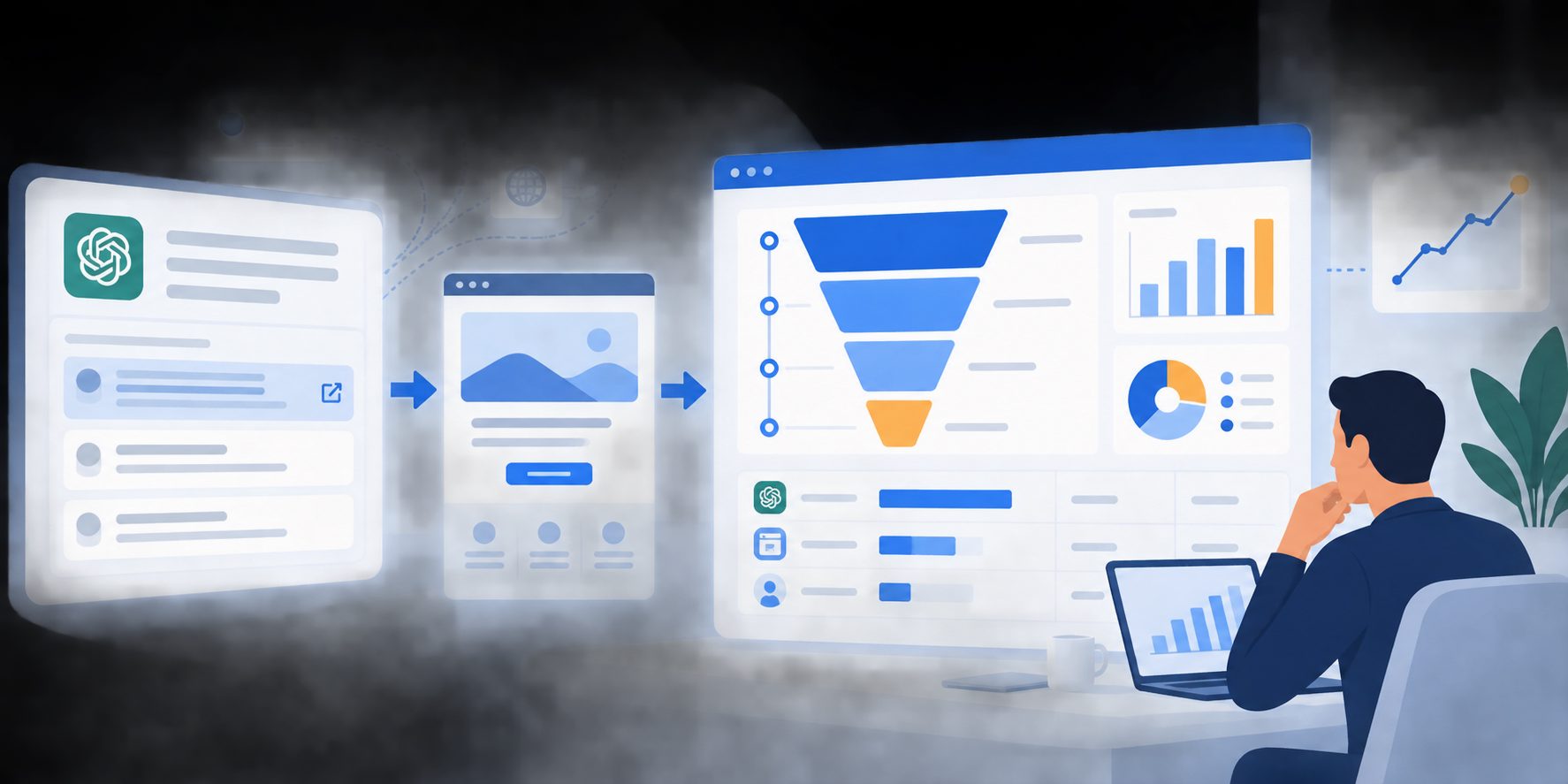
Build a unique-user, ordered funnel beginning with AI Referral Landing and ending with the conversion that represents real product intent. A trial-start funnel is more decision-useful than a pageview-to-signup report because it excludes registrations that never reach the product.
Configure these steps:
AI Referral LandingSignup StartedSignup CompletedTrial Started- Optional:
Activated
Use specific-order conversion and count unique users. Start with a window that reflects your normal signup cycle, then compare shorter and longer windows—for example, one, seven, and 30 days—to expose delayed conversions.
Mixpanel notes that funnel results depend on counting method, conversion window, step ordering, exclusions, and constant properties. (mixpanel.com) Break the report down by landing page, device, country, plan intent, and first-touch versus converting-session source.
For broader pipeline reporting, connect this analysis to a defensible method for calculating organic traffic’s contribution to B2B SaaS pipeline.
How should the setup be validated before reporting?
Validate the complete journey with controlled test visits, not only Mixpanel’s event debugger. A correct landing event is insufficient if attribution disappears during a redirect, domain change, consent update, signup, or server-side trial event.
Run this six-case QA matrix:
- Visit from a URL with a simulated
chatgpt.comreferrer in a controlled test environment. - Visit with only
utm_source=chatgpt.com. - Visit with both signals and confirm only one entry event fires.
- Sign up in the same session and verify identity merging.
- Start a trial after returning in a later session.
- Visit directly and confirm it is not falsely classified as ChatGPT.
Also test incognito mode, mobile browsers, consent rejection, and marketing-to-app redirects. Keep development and production data separate, and inspect individual event timelines before trusting the aggregate funnel.
What is the two-ledger framework for AI attribution?
Use two separate measurement ledgers: an observed referral ledger for attributable clicks and an influence ledger for visibility signals that may not produce a traceable referral. Combining them into one number creates false precision; reporting them side by side preserves what the evidence can actually prove.
The observed referral ledger contains:
- Identified ChatGPT referral visitors
- Signup and trial conversion rates
- Landing pages
- Time to conversion
- Activated accounts or qualified pipeline
The influence ledger contains:
- Brand mentions and citations
- Prompt coverage
- Citation frequency
- Branded search movement
- Direct-traffic changes on cited pages
This distinction connects product analytics with tracking entity mentions across ChatGPT and Perplexity and measuring brand visibility in ChatGPT answers. The referral funnel proves attributable behavior; the influence ledger supplies context without pretending that an untagged visit has a known source.
How should SaaS teams interpret the results?
Compare ChatGPT traffic with other channels using identical funnel definitions, windows, and identity rules. A higher apparent conversion rate may reflect stronger intent, but it can also result from a small sample, a narrower landing-page mix, or missing low-intent visits.
| Pattern | Likely interpretation | Next action |
|---|---|---|
| High signup, low trial rate | Messaging attracts interest but onboarding loses users | Segment onboarding drop-off |
| Low traffic, high trial rate | Small but commercially relevant channel | Expand citation-worthy content |
| High referrals to one page | Citation concentration | Strengthen related topic clusters |
| Direct traffic rises with AI mentions | Possible dark influence, not proof | Compare pages and branded demand |
| Funnel breaks after signup | Identity or cross-domain issue | Audit IDs and attribution transfer |
For strategic context, benchmark GEO visibility against competitors before concluding that referral volume alone represents your full AI-search position.
Frequently asked questions
Can Mixpanel reveal the prompt that sent a visitor?
No. A referrer or UTM value can identify the visible source, but it does not expose the user’s private ChatGPT prompt. Prompt monitoring and referral analytics must remain separate datasets.
Why does ChatGPT traffic sometimes appear as direct?
The referral signal may be removed, or the user may copy and paste the URL. Mixpanel cannot reliably distinguish such visits from bookmarks, typed URLs, or other untagged sources.
Should the funnel begin with any pageview?
No. Begin with a dedicated AI Referral Landing event or an equivalent pageview filtered by validated source properties. A dedicated event simplifies QA and prevents unrelated pageviews from entering the denominator.
What is the best way to track ChatGPT referral conversion rate in Mixpanel?
Capture referrer and UTM evidence at entry, preserve first-touch and session attribution, merge anonymous and authenticated identities, and use a unique-user ordered funnel ending in Trial Started or another meaningful SaaS conversion.

